 Damon Chen
What to take from this
- 1
The free plan keeps collecting after two videos or ten written testimonials. The business pays to access the excess; the customer who took the trouble to respond is not turned away.3
- 2
Permission travels with the testimonial. The saved record includes what the customer agreed to, in which language, and when. A screenshot of praise cannot do that job on its own.5
- 3
Chen's $800K ARR, $2M total revenue and $109K MRR are all about Testimonial. They are three different readings between 2023 and 2025, not rival estimates of this year's sales.8,9,10,11
Snapshot
Testimonial earns its fee when a business needs to do something with the next customer's reply. Consider a consultant who has two good video references on her site. A third client records a recommendation. On the free plan the submission can still come in; the consultant now has a reason to upgrade that she did not have when she sent the request. Starter removes the limit on written responses but still allows access to just two videos. She can buy Ultimate for the third video, ask for a written version, or continue displaying the two she already has. Those are materially different decisions.3
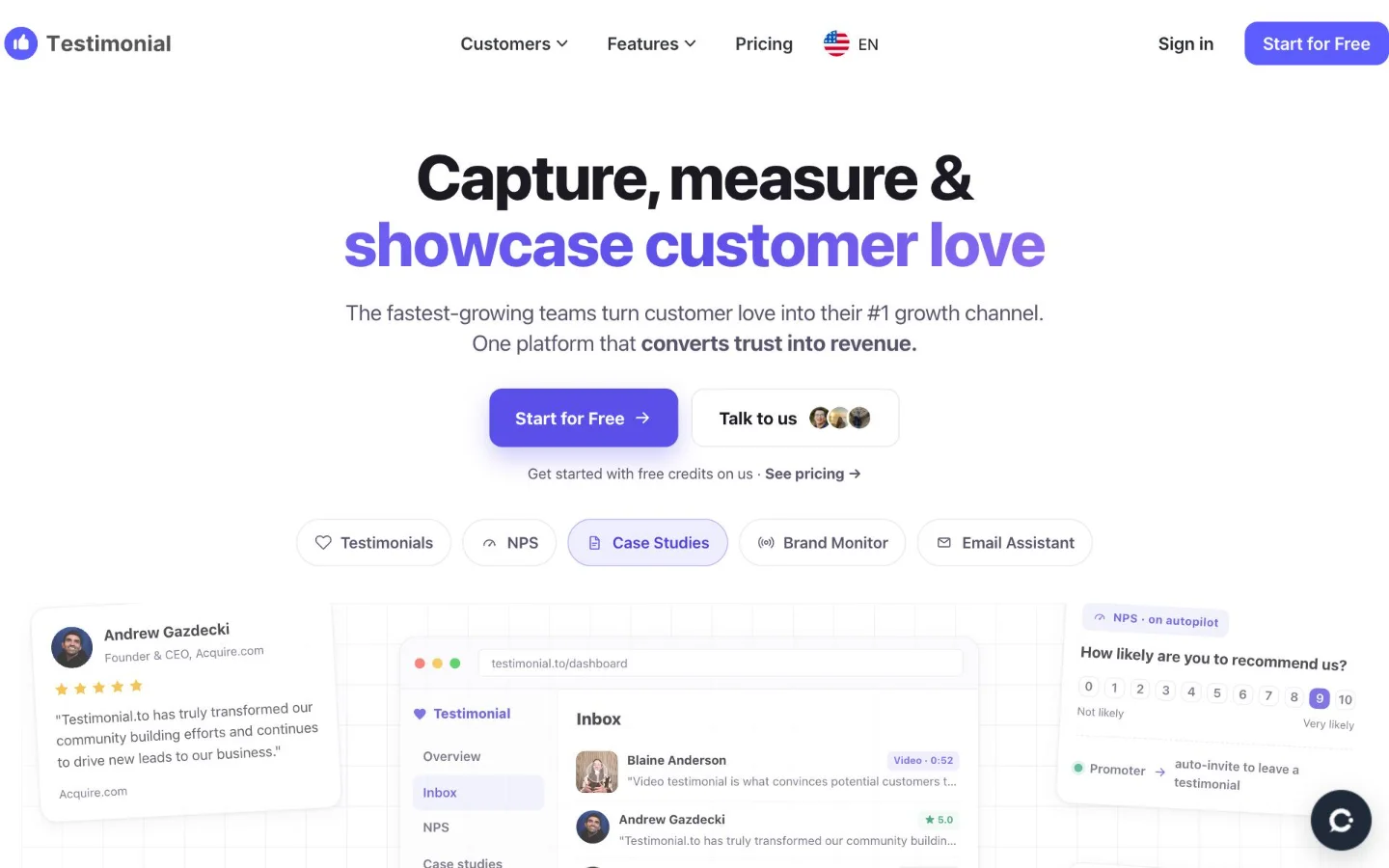
What she buys is a way to ask, keep the original permission, select a response and display it where a prospect can use it. A collection page, a record of consent and a Wall of Love are parts of the same transaction. They are valuable together even when none of them individually justifies another software subscription.3,5,66
Customer and problem
The payer is the business requesting a reference, not the person giving one. A marketer can already ask by email and add a quotation to a website. That works well for a single client who knows exactly where the quote will appear. The extra work starts when different colleagues ask for references, a video arrives separately, or someone later asks whether the customer approved its use on social media. A wall solves the display problem. The collection form solves a different problem: preserving the speaker's answer and permission together.3,5
Testimonial's guide makes the difference inspectable. Consent is required by default but can be optional or hidden. Changing the wording later does not rewrite an existing submission. A team can retrieve the original wording from the activity log or a CSV export. For someone approving a campaign, that is a more useful reason to keep a system of record than a promise that testimonials will increase conversion.5
Offer and pricing
The first paid decision is about format; the second is about how many spaces the team runs. On November 19, 2026, month-to-month prices were $30 for Starter, $60 per space for Ultimate, and $120 per space for Ultimate+. With annual billing the actual charges were $300, $600 per space and $1,140 per space respectively. Enterprise was by quotation. The free allowance is total, not a fresh allocation every month; the pricing FAQ distinguishes receiving a submission from accessing it. Paid plans advertise a seven-day trial.3
An agency evaluating this for two client brands should therefore price the second space before choosing a plan. Unlimited testimonials in one space do not mean unlimited client spaces. Ultimate lists automated invitations and integrations; Ultimate+ adds case-study collection and surveys. A small practice that already has enough written references might get everything it needs from the free wall and never become a paying account.3
How it gets customers
The wall can introduce the product to the next buyer while doing useful work for the current one. In Peter Yang's November 2023 interview, Chen described visitors seeing the Testimonial logo on a customer's wall and signing up themselves. He also credited people he knew through IndieLog and Indie Hackers with early purchases. One pathway requires a published wall; the other required relationships that existed before this product.7
Referrals have an explicit price. Chen estimated in that interview that affiliates contributed about 10–15% of revenue at the time. The program inspected for this edition offers a partner 30% of the referred customer's monthly subscription fee for the first twelve months, and the customer 15% off for the first year. It excludes self-referrals. The current terms are the useful source for planning a referral today; the interview is the source for the historical channel share.6,7
Costs and margin conditions
A video account and a text account leave different work for the seller even at the same subscription price. Recording, storing, transcribing and serving videos persist after the collection form closes. The plan comparison limits recordings to two minutes on Free and Starter and five minutes on Ultimate, and sets separate budgets for invitations and brand mentions. Those limits describe what the service has agreed to deliver. They are more informative about exposure than a count of logos on the pricing page.3
The buyer also retains work: choosing whom to ask, reviewing submissions and respecting their permissions. The terms require the contributor to have the relevant rights; the consent record helps the marketer make a decision rather than making it for them. On the seller's side, an affiliate payout comes out of a referred subscription before the costs of providing the service.4,5,6
Revenue evidence and trajectory
Use the product-specific figure that answers the question being asked. These are the four source readings behind the three often-repeated numbers:
- September 1, 2023: Chen assigned $800K ARR to Testimonial and $200K ARR to PDF.ai in the same post. Use $800K for this dated annual run rate. Peter Yang's November 29 introduction later described Testimonial as $800K+ ARR; that is the interviewer's threshold, not an additional product or receipt.8,7
- October 15, 2024: Chen said Testimonial had reached $2M in total revenue after almost four years. Use it for accumulated revenue since launch. He did not call it annual revenue, profit, or four completed financial years.9
- November 26, 2025: Chen wrote $109K MRR. His link resolves to a Stripe-hosted chart for Testimonial labeled MRR, displaying $109,482.09 with an axis ending in November 2025. Use the rounded amount when quoting Chen and the exact display when describing that chart. The two readings describe the same milestone.10,11
Risks
A finished marketing site can outlast the buyer's need for a collection subscription. The pricing FAQ says videos can be downloaded as MP4s. A customer who wants one launch campaign can keep the files; one continually requesting, approving and showing new references has a different reason to renew. A wall becoming more valuable over time is plausible for the latter customer, not a property of every account.3,5
What transfers and what does not
Let the respondent finish the job before asking the business to pay. That design fits because the person doing the work and the person paying the bill are different people. It would be a poor lesson to copy the launch price instead: Chen recalled about thirty $199 lifetime deals and roughly $6,000 in the first two weeks. That was evidence that people would buy the early version, before the switch to subscriptions. It did not establish that thirty customers would renew.3,7
Unknowns
The public evidence stops short of a November 2026 revenue reading. The shared Stripe chart is historical and does not reconcile other payment channels, refunds or lifetime deals. We do not have renewal rates by space, the number of paying companies, margins on video-heavy accounts, or a measured signup-to-sale rate for wall visitors. Those missing numbers matter more to the economics of copying this offer than another rounded ARR headline.3,7,10,11