 Pieter Levels
What to take from this
- 1
Levels has published four Photo AI figures, and they measure different things: $61,808 a month from 1,872 paying customers in July 2023, a $161K/m rate on a single record day in September 2024, $105K a month of revenue and $80K of profit in March 2026, and $68K/m in his November 2026 bio. The bio does not say what window it covers, so it cannot settle whether sales fell.10,11,12,2
- 2
The plans sell credits, not photos. Starter's 50 monthly credits buy five Nano Banana 2 photos; a video with sound costs 300 credits. Once you have created a model, or generated 20 or more photos, you can no longer get a refund.3,4,5
- 3
Margin depends on which models he routes jobs to. Levels said the Photo AI GPU bill fell from $36,000 to $7,000 a month after he switched video models and rerouted jobs.13
Snapshot
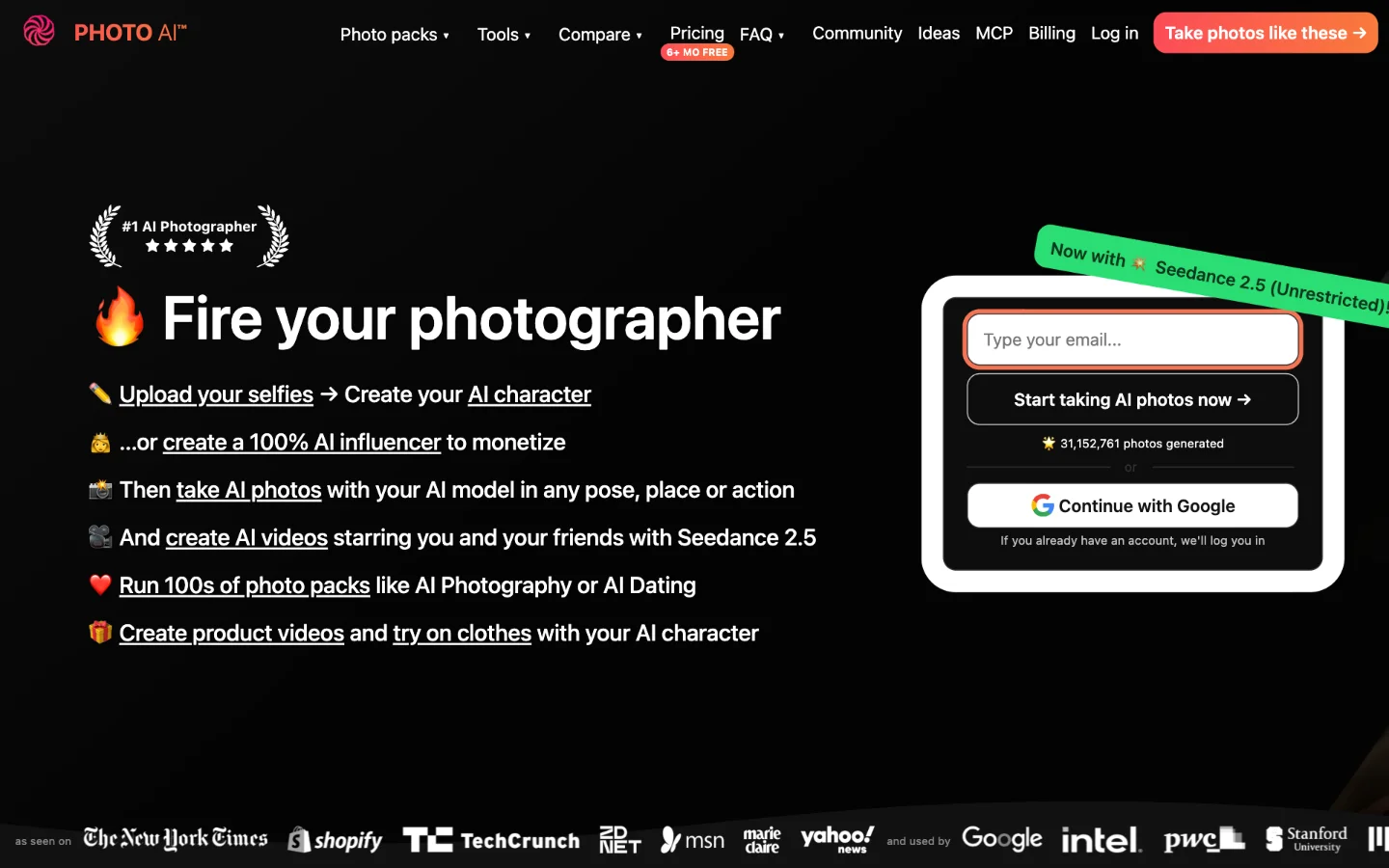
Photo AI sells photo shoots without a photographer. The customer uploads pictures of a person, Photo AI trains a model of that face, and the subscriber then generates photos, and on higher plans videos, in any setting. Levels launched it on February 10, 2023, after his Avatar AI experiment, and the product's footer still says it was formerly known as Avatar AI. Its FAQ states that he built it, runs it alone and owns all of it.9,3,8
The strongest evidence is a run of dated revenue posts from the founder, including a screenshot whose app header read $62K MRR in July 2023. No payment-connected public view was found for this edition. Every revenue figure below is therefore Levels's own account, and each covers a different window.10,12,2
Customer and problem
The buyer already owns a phone camera and can hire a photographer. What Photo AI changes is the cost of the next picture. Once a model is trained, a dating-app photo, a LinkedIn headshot or a beach shot costs credits instead of a booking. In his August 2024 Lex Fridman interview Levels described the idea as "fire your photographer".14,3
There are two kinds of payer. Individuals buy for profile, dating and headshot photos; the pricing page gives each new model 48 free auto-generated photos in those categories. Businesses buy for commercial use. The Pro plan adds a commercial licence, and Max adds clothes try-on aimed at Shopify stores. The buyer still has to supply usable photos and wait for training. On Starter they also accept what the page calls low quality and low likeness, with no commercial-use licence.3
Offer and pricing
The real choice is how many credits a month you need. On November 25, 2026 the monthly prices were $19 for Starter, $49 for Pro, $99 for Max and $199 for Ultra. Yearly billing cost $99, $349, $599 and $1,199, which the page presents as $9, $29, $49 and $99 a month. The plans come with 50, 1,000, 3,000 and 10,000 credits a month. Annual subscribers also receive their credits monthly.3,4
The credits table shows where the allowance goes. A Hyper Realism photo costs 5 credits, a Nano Banana Pro photo 10, a 3D model 25, and a video with sound 300. Only Max and Ultra list video shooting, and Max's allowance is quoted as 16 fifteen-second Seedance videos. Extra credits can be bought at a volume discount and last two years, while plan credits expire monthly.3,4
The refund rule matters as much as the price. You can refund yourself only if you have not created a model, have generated fewer than 20 photos and did not sign up through a referral link. The FAQ's reason is cost: upstream providers do not refund GPU time, and customers waive the refund right at sign-up. Cancelling stops future charges.5
Consider someone who needs one set of LinkedIn headshots. The 48 free headshot-style photos for each model may cover the job in the first month, and then there is no reason to keep paying. The plans are built for repeat users such as creators, sellers and people who keep producing content.3
How it gets customers
Attention arrives in bursts, and Levels has said which bursts worked. After his Lex Fridman episode he reported a record day, with revenue up 2.5 times and Photo AI up three times. In the same post he said a national TV appearance brought him about three sign-ups.11
In that interview he also said a TikTok video made by someone he did not know added about $20,000 a month, although the transcript does not clearly name the product, and that such creators sometimes ask to be paid to do it again. Paid creator posts are therefore a cost he has acknowledged, even though no budget is published.14
The referral programme pays in credits. Both people get 1,000 credits, or 100 if the referrer is on Starter, and referred accounts lose the right to a refund. Paying in credits means rewarding a referral costs him compute rather than cash.6,5
The rest is visible on the site. The pricing page footer links to dozens of themed photo packs, comparisons against tools such as Midjourney and free image utilities. These read as pages built to be found in search, although this edition has no traffic data to show how many customers they bring in. His own X audience, close to a million followers when the profile was read, is where he launches features such as the August 2026 video editor.3,2,17
Costs and margin conditions
Most of the cost is compute, and Levels's figures show it moving a lot. In September 2024 he put the GPU bill at about $60,000 for Photo AI and Interior AI together. On November 3, 2026 he said switching to cheaper video models, using Google Cloud credits and routing some jobs to a provider selling at market cost had cut Photo AI's GPU bill from $36,000 to $7,000 a month. Storage on Cloudflare R2 fell from $1,200 to $800.11,13
Vendor pricing is also a risk. He told Lex Fridman that in the Avatar AI period a training platform raised its price from $3 to $20 per model while he was charging about $30, and that this wiped out his profit until Replicate added the fine-tuning he needed. He later invested in Replicate and fal, both inference companies his photo apps used.14,16
The margin claims fit this picture. The for-sale FAQ states 75%–90% profit margins. His March 2026 post gave $80,000 profit on $105,000 revenue, about 76% by our arithmetic. The November post does not say when the GPU savings began, so the two posts cannot be combined into a later margin.7,12,13
Revenue evidence and trajectory
Read these readings as separate observations, not one series:
- July 3, 2023: $61,808 a month from 1,872 paying customers, about $33 per paying customer by our division. The screenshot's app header read $62K MRR and 605K photos a month.10
- September 22, 2024: $161K/m within a $420K/mo portfolio record that Levels said lasted about one day and "already dropped WAY down".11
- March 6, 2026: $105,000 a month of revenue and $80,000 a month of profit.12
- November 25, 2026 (bio): $68K/m, with no window stated.2
The March and November figures are the closest pair. If both are monthly revenue, Photo AI's run rate fell by about a third. If the bio uses a different window or definition, it did not necessarily fall. The sources do not say which.
Risks
Competitors can copy the core quickly. Levels recalled that Lensa built an iOS app on the same open technology during the avatar wave and, by his estimate, made about $30 million. The plan table now names third-party models such as Nano Banana 2 and Seedream next to Photo AI's own Hyper Realism pipeline. The same model releases are available to every competitor.14,3,4
The business depends on one person. The FAQ says Photo AI has no employees and that Levels would sell it for the right price, although he is not rushing to.7,8
What transfers and what does not
Two parts of the design can be copied: charge before the compute runs, and tie refunds to usage. Credits also let him swap a costly model for a cheaper one without changing what the customer sees. The burst of customers after a long-form podcast cannot be copied, and neither can an audience of close to a million followers. A newcomer would have to pay for that reach.5,13,11,2
Unknowns
The edition has no current subscriber count, churn rate, split between plans and credit top-ups, or share of revenue from video. It is not known what the $80,000 profit deducts, or what period the $68K/m bio figure covers. No payment-processor view was available to check any of these figures.