 Daniel Nguyen
What to take from this
- 1
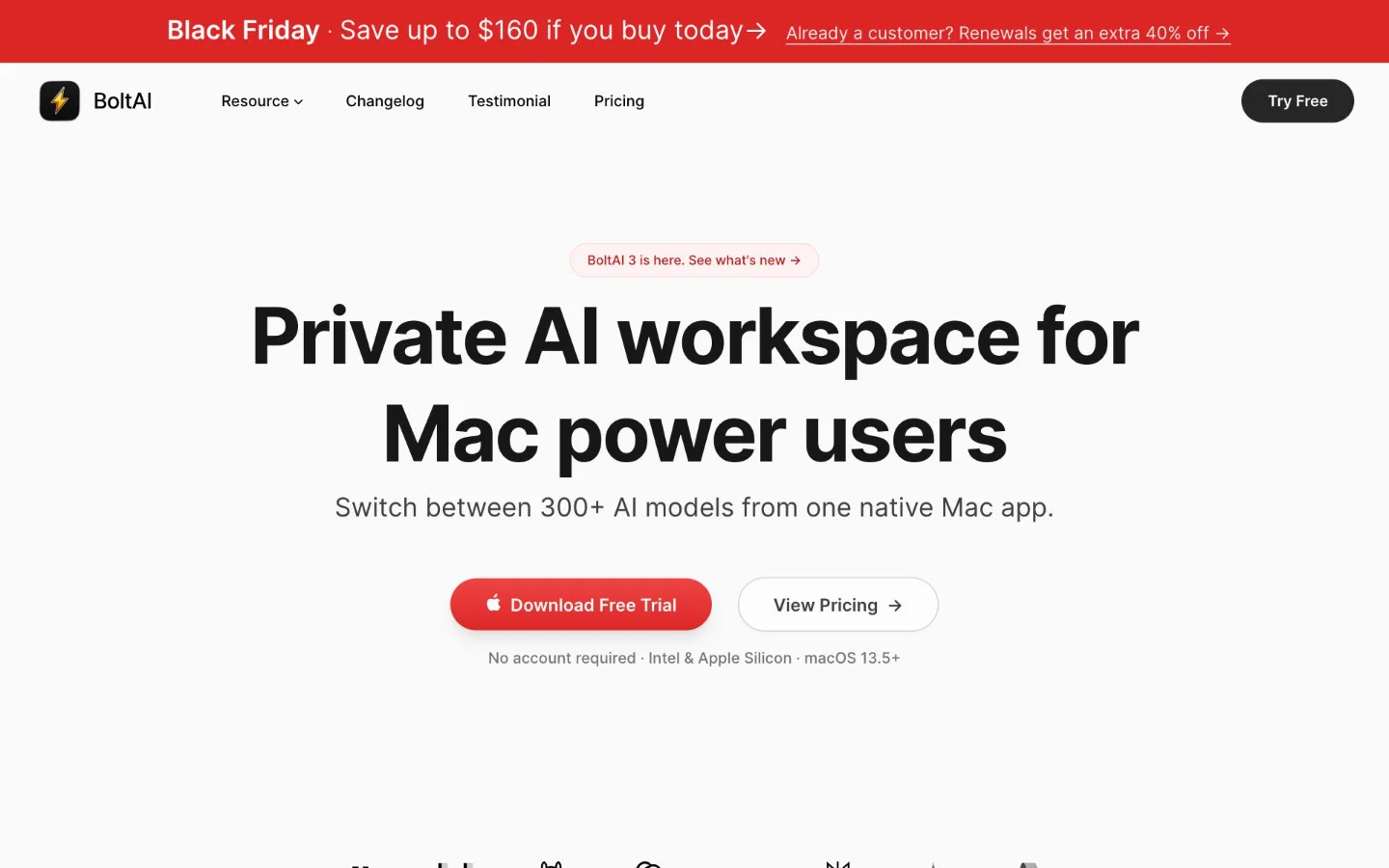
BoltAI sells a workspace, not an unlimited supply of AI responses. A Mac user can buy the client, use a local model or connect a provider, and keep the last eligible desktop version without buying another year.3,6,64
- 2
The $5K in a September 2024 interview card was not the best available estimate of BoltAI sales. Daniel Nguyen put the mixed-channel average at about $15K a month; in March 2025 he reported a $15K–$30K range and an average of about $25K.8,7,10
- 3
Giving away one feature produced a measurable visit, not necessarily a sale. Nguyen reported 1,700 visitors from the free ShotSolve app, whose own site explains that it uses BoltAI's engine.7,37
Snapshot
The first thing worth buying was a way to stay in Apple Notes. Nguyen wanted to call a model and generate an image while writing, without moving a draft to another window. He called the prototype BoltGPT and reported about $500 of revenue in its first month. Early users then asked for a place to keep their conversations. The result was a chat window alongside the original in-app commands. That sequence explains why a customer with access to the same model might still pay for a client.67
The current seller has a name as well as a face. The press kit names Podzim LLC as developer and Nguyen as the company's founder; the terms name the LLC as service provider. As of November 19, 2026, the About page said 20,000+ users and 220+ public Mac builds. Its claim to operate profitably comes from the company. Neither the user counter nor the release count gives a margin or a number of full-price licenses sold.2,4,5
Customer and problem
The best fit is someone who keeps moving work between a model and a Mac application. A writer can invoke a saved instruction on selected text; a developer can keep a conversation alongside a project and switch providers without starting another library. In contrast, for someone who only needs to ask an occasional question in a browser, the direct license buys a second interface to something they can already do. The purchasing test is whether the saved steps recur in real work.3,4,67
There is also a purchasing decision for the person responsible for the data. In the desktop app, local inference can keep a conversation on the Mac. With a cloud model, the selected provider receives the messages and relevant attachments; optional Cloud Sync adds another destination. A buyer can therefore choose where computation happens, rather than having to accept one data path for every task. The mobile defaults are different and need a separate review.64
Offer and pricing
The three individual direct licenses differ chiefly in device count and future entitlements. On November 19 the USD list and Black Friday prices were Pro $99 → $59 for two desktops and one mobile device; Pro+ $199 → $119 for three desktops and two mobile devices; Lifetime $399 → $239 for five desktops and three mobile devices. Pro and Pro+ include one year of updates, versus lifetime software updates in the top tier. The comparison guide lists another tier, Essential, but the public individual sale presented those three offers.3,6
Perpetuity refers to using the purchased desktop version. Letting the update period lapse on the ordinary tiers also changes access to sync and mobile. Teams get a distinct offer: $99 per seat, at least five seats, with $79 per seat per year for optional renewal. In 2024 Nguyen discussed a future team subscription; the offer visible at cutoff is Team Perpetual. There is a 14-day trial without Cloud Sync, so buyers can test the local workflow before making either commitment.3,6,7
How it gets customers
Different channels solved different problems. Posting weekly feature updates on X and getting a repost from Pieter Levels helped people discover the app, according to Nguyen. He subsequently experimented with directory placements and paid promotion, wrote help articles, and spoke to active customers about features worth sharing in their own communities. In the October 2023 interview he identifies one directory whose initial unpaid traffic made a paid placement worth trying. That is a more concrete decision rule than treating a viral post as a repeatable campaign.7,11
Setapp supplied both distribution and a different source of money. Nguyen said people found the product through Setapp's promotion and some bought the direct license instead. ShotSolve offered a second way to experience the product: try a screenshot question, then follow a link to the larger workspace. His visitor figure describes only the latter path; it cannot price the value of either channel.7,37
Costs and margin conditions
Bringing a model account removes one variable expense from a direct license, but it does not make future service free. Under the user's own key the provider bills that user; local inference instead uses the machine. Setapp has its own AI entitlement and credit system for some requests. Direct customers can also need sync, storage, updates and human support. A hosted feature should not be costed as though it were a local model.5,6,64,65
Engineering work continues after the sale. The November 9 release added built-in local models; two days later the release notes describe automatic context compaction and OCR for scanned PDFs. A perpetual-license buyer might value that improvement enough to renew, or already own a version that does all they need. Only the former decision creates another update sale.3,66
Revenue evidence and trajectory
The strongest historical reading changes with the question, not with the biggest headline.
- September 11, 2024: Indie Hackers' card says $5K a month alongside three company names. Its editorial lead instead says $10k/mo in one-time sales and $5k MRR. The card doesn't define what it counts. The lead is the source of the split, not a processor statement or two additional amounts to add to the headline.8
- September 29, 2024: Nguyen's unedited answers identify BoltAI, website licenses plus Setapp subscription revenue, about $15K/mo on average. Prefer this for the product total. He does not provide the dollar split in that answer. On January 8, 2025, he also told High Signal the app generated about $15k per month; publication on a second date does not establish a second measurement window.7,9
- March 6, 2025: Nguyen identifies $15k–$30k/mo for BoltAI, with about $25k per month on average in the interview. The average is his number, not our midpoint. The $18K–$34K/month card lists three companies; the text also names PDF Pals and KTool separately. The interview emphasizes non-recurring license sales without reconciling the earlier Setapp stream. Use the range for historical variability, not a $30K subscription run rate.10,7
- January 27, 2026: Nguyen edited his GitHub profile to attach $500K+ to BoltAI as his top revenue-generating product. The dated diff preserves the disclosure; it gives neither a monthly unit nor the start of the measurement period. It is a product milestone, not evidence of a November sales month.14,15
Risks
Pricing for fewer, better-fit buyers can reduce revenue as well as support. Nguyen said that after moving from $19 toward $79, monthly revenue at $79 was slightly lower than at $39, but the buyers needed less support and requested fewer refunds. That is a reported trade, not a price-elasticity experiment. It matters because the company promises real human support irrespective of which promotion brought in the buyer.7,2
What transfers and what does not
Copy the question that defined the first release: which work should the customer no longer have to interrupt? Nguyen could answer with a specific editor, an action and an output. ShotSolve shows a second useful test: can someone experience a single action without buying the whole workspace? What does not transfer automatically is his installed base, a partner's merchandising or the ability to maintain native integrations across changing versions.67,37,7,66
Unknowns
No payment-connected product statement in this edition establishes current receipts, renewal rates, Setapp's share, refunds or profit. The interviews do not identify the months averaged, whether sales are before or after fees and taxes, or how many marketplace users later paid directly. The January 2025 interview's more than 7,000 customers and the About page's 20,000+ users cannot be subtracted to calculate new paying customers.7,9,10,2