 Tony Dinh
What to take from this
- 1
The buyer pays twice, to different parties. A TypingMind licence unlocks the interface once; every message is billed separately by OpenAI, Anthropic, Google or another provider on the buyer's own key.4,5
- 2
The one-time licence rests on a separate subscription line. TypingMind's FAQ answers how a lifetime deal survives by pointing to the Teams subscription, and by October 2025 Dinh put recurring team revenue above half of the monthly total.5,10,12
- 3
Every revenue figure is his own. They run from $22K in the first week (March 2023) to $1M over the 12 months to November 2024, $210K+ in December 2025 and $137K a month in his X bio at cutoff. None is tied to a payment-provider view.9,11,13,1
Snapshot
TypingMind sells a better place to talk to AI models, not access to the models themselves. Someone who already pays per token through an API key can open the free web app, connect that key and chat; the paid licence removes pop-ups, keeps history and unlocks features such as agents, web search, documents and parallel chats across models. A company that wants the same interface for its staff, under its own domain and with admin controls, buys a monthly or annual Teams plan instead.4,5,6
Dinh registered the domain the day after OpenAI's ChatGPT API announcement in March 2023 and released the first version on March 6. He tweeted each feature as he shipped it and reports $22K of licence sales within a week, including a Product Hunt day that he says added about $5K.9,21 The product is now operated by Typing Technology Co. Ltd., whose terms separate a personal licence that never renews from a team licence that does.7 The main limit of this report is that all revenue figures are Dinh's own statements in his newsletter, on X and in his bio, with different periods and definitions.
Customer and problem
There are two buyers with different problems. The individual is a heavy AI user who wants several models in one window, a searchable history and tools such as prompt libraries, without paying a separate monthly plan to each vendor. TypingMind's own comparison page frames the licence against ChatGPT Plus or Claude Pro at $20 a month: pay once, then pay per token.4 That works for someone who uses a little of several models; a person who uses one model heavily inside a flat-rate plan may find the API bill higher than the subscription.
The company buyer wants an internal AI workspace: staff log in, admins choose models, set usage limits and see logs, and the company's own API keys stay hidden from users. The Teams FAQ says requests go through TypingMind's servers, and the business pays the AI providers directly.6 Dinh described this buyer in November 2024 as enterprises setting up internal AI platforms, citing one 3,000-seat deal and several 1,000-seat deals.11
Offer and pricing
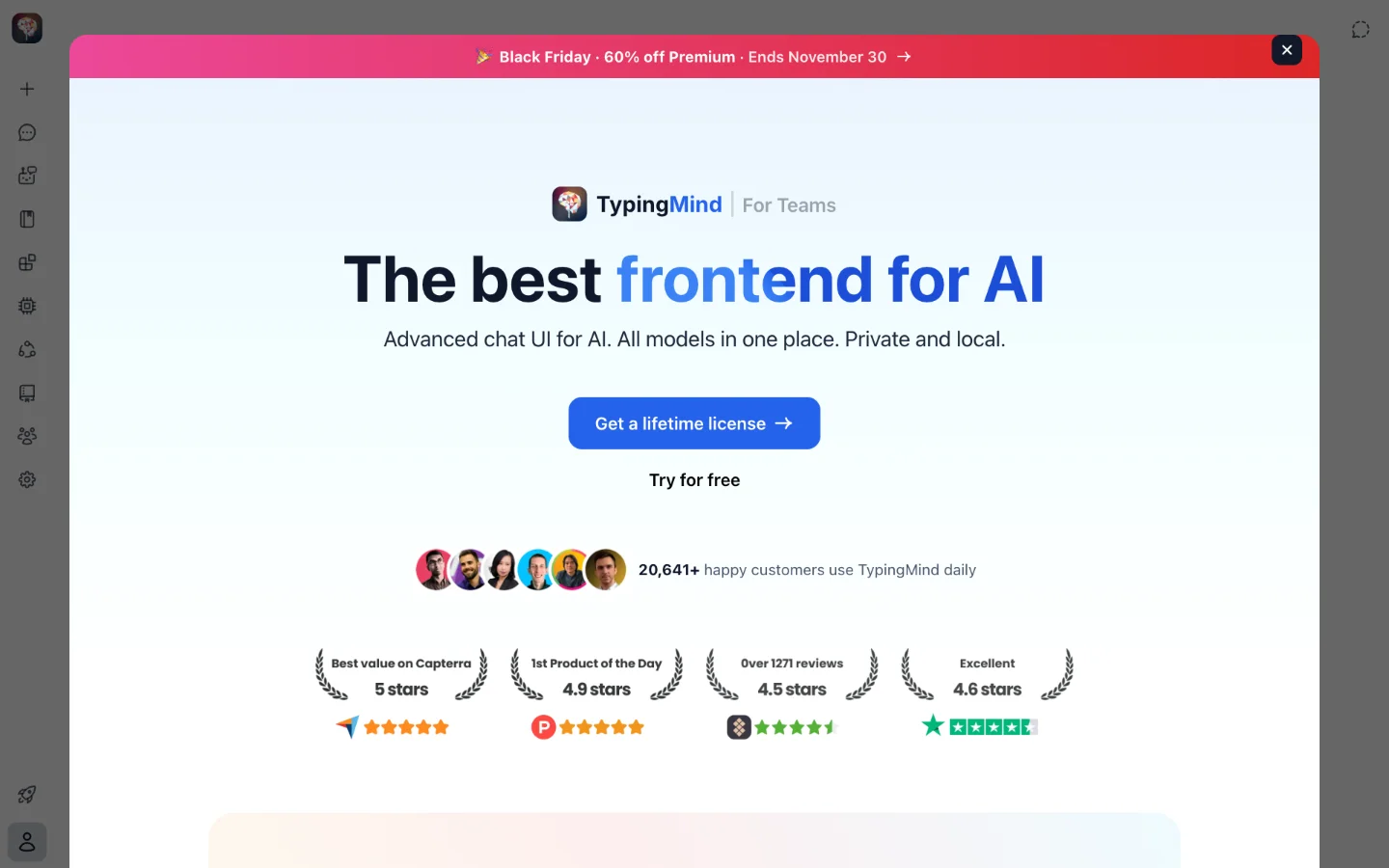
The personal offer is a one-time licence in three tiers. On November 27, 2026 the buy page listed Standard at $39, Extended at $79 and Premium at $198, with a Black Friday code cutting Premium to $79.20 until November 30. Only Premium lists free updates. A bulk licence for up to 10 users on 50 devices was $790, shown at $395 during the sale. The page states that prices exclude API costs and extra cloud storage, offers a 14-day refund and says there is no renewal.4 The FAQ adds the practical limits: a licence covers five devices, the free plan does not save chat history, and TypingMind Cloud sync is a separate opt-in service with its own paid upgrades.5
The Teams offer is a subscription with five seats included. Billed monthly, Starter was $99, Growth $199 and Professional $299 against a struck-through $599; billed annually the same tiers worked out at $83, $166 and $249 a month. Extra seats were $8 each per month. A custom Business tier was quoted from $18,700 a year, with volume pricing down to $4 per seat per month. Every tier excludes model usage.6 TypingMind is also listed in Setapp's Mac subscription bundle, a third route whose revenue share is not public.22
How it gets customers
Dinh's own account is that the personal licence is the funnel and word of mouth is the channel. In November 2024 he wrote that one-time licence volume had kept rising for 20 months, that the app was mentioned on Reddit almost daily, and that some licence buyers moved to the team version. Paid ads and sponsorships, he said, had produced terrible results.11 In October 2025 he called most sales word of mouth and reported a $600 ad test that produced two conversions.12
At launch the route was his own following: he tweeted each new feature and credited his Twitter audience and newsletter readers with the Product Hunt #1 finish, while writing that he could not tell what made the launch work.9 Later B2B work was slower and more manual, with video calls, sales cycles of months and a reseller programme under which local partners sell TypingMind under their own brand and pay him a platform fee.11 In June 2026 he relaunched on Product Hunt, writing that he had neglected launches for three years.20
Costs and margin conditions
The licence can be sold once because the core app has no server bill. Dinh explained in 2023 that the original TypingMind was a static web app with no backend or database, with API keys stored in the user's browser, which is why a one-time price was affordable.9 The FAQ still describes requests going straight from the browser to the AI provider.5
Costs arrive with the features that need servers. Cloud sync and the team version require servers and databases, so Dinh charged subscriptions for them; in February 2024 he wrote that subscription revenue covered the cost of lifetime users, mostly support.10 Selling to companies brought compliance costs: SOC 2 for under $10K a year by his account, and at least $20K spent on SOC 2, HIPAA, GDPR, audits and contracts by November 2024.19,11 In July 2024 he described a team of five, two of them full-time; he does not publish payroll.19
Revenue evidence and trajectory
Read the readings in date order and note what each one measures. All are founder-reported.
- March 2023: $22K of licence sales in the first seven days, after which he stopped sharing launch revenue.9
- May 2023: custom deployments and a related offer, ChatOrigin, brought $2.6K MRR.16 By early August 2023, TypingMind Custom alone was at $6K MRR at $79 a month, with one B2B contract worth $20K.14
- September 2023: about $30K a month on average for the whole app.15
- February 2024: $500K total revenue since launch, and $15K MRR from the subscription part only.10
- November 2024: $1M of revenue in the last 12 months, from his profit-and-loss statement; one-off sales were still the larger source but about 50% of the monthly total.11
- October 2025: about $130K to $160K a month, with team recurring revenue above 50%.12
- December 2025: $210K+ in one month, which he called an all-time high, plus 8,000+ new customers over 2025.13
- November 2026: his X bio reads "$137K/m" next to the domain, with no month given.1
The bio figure is the latest, but it is a profile label that could have been written at any time before inspection. The December 2025 figure is one month he singled out as a record, not a run rate.1,13 None of these figures is net of the AI costs customers pay elsewhere, because those never pass through TypingMind.
Risks
The product depends on model providers allowing bring-your-own-key clients and on keeping pace with the providers' own apps. Dinh wrote that the official ChatGPT interface fixed several of the early annoyances within months, and that he had to ship constantly to stay ahead.10 The about page claims 1,048 company AI platforms created; the FAQ claims more than 5,000 businesses. Neither number says how many pay.8,5
The other risk is the licence promise itself. Premium buyers are promised updates forever, so every new feature that needs a server has to be paid for by another line. Dinh named this constraint himself.10
What transfers and what does not
The transferable idea is the split: sell the client once, sell the hosted team service by subscription, and keep variable model cost on the customer's own bill. Dinh himself points to two conditions a copier may lack: being first to the niche, days after the API appeared, and an existing audience of about 76,000 followers on Twitter.10,9 A founder without that reach would be testing a different launch. His $22K week does not show how many of those buyers stayed, and his later results do not show which channel produced each sale.
Unknowns
There is no payment-processor view, no split between licence, Cloud, Teams, bulk and reseller revenue after October 2025, no count of paying companies and no profit figure for TypingMind alone. Setapp's contribution is unknown. Whether the $137K bio figure describes a single month, an average or a run rate is not stated.1,12,22